Emma’s red-string wish ritual
The ChangelingEmma’s red-string wish ritual is a three-wish custom that makes patience part of the wish: after wishing, Emma Valentine must let a red thread wear away and fall from her wrist, not cut it off. Apollo Kagwa’s decision to sever it turns a private, half-playful belief into a promise between them. The string then recurs as a keepsake and, much later, as the vow Apollo chooses to keep when he casts aside his wedding ring. Its importance lies less in proof that magic works than in how a fragile object carries desire, memory, and commitment through changing circumstances.
Origin and Rule
Emma learns the ritual in Salvador, where she is staying with a family in Itapuã. She spends time beside Lagoa do Abaete with a washerwoman she befriends after improving her Portuguese. Emma’s host family warns her away from the woman, calling her a witch, but Emma is drawn to her toughness and humor, which remind her of Emma’s mother. Before Emma leaves for Manaus, the woman tells her to make three wishes for her life and ties a red string around her wrist.
The rule is specific: Emma must let the string come apart naturally, and her wishes will come true when it falls off. She is not to cut it. At first she treats the custom as a bit of fun and mystery, but the thread stays on her skin for more than six months. By the time she returns to Apollo, it has become stiff and dirty. Its worn condition is not evidence that the wishes have been granted; rather, it shows how long she has chosen to live with the rule and hope attached to it.
Emma explains the ritual over a meal, turning her wrist to look at the red fabric. Apollo has already noticed the thread and imagined that it might be a keepsake from another romantic attachment during her year away. Her explanation replaces that anxious guess with a story about a friendship, a journey, and wishes she has not abandoned. The thread makes Emma’s time away materially present at the table, even as its meaning is something Apollo must learn from her.
Apollo’s Intervention and Promise
After hearing Emma’s account, Apollo takes her hand and cuts the string with a plastic knife. The action is immediate and deliberate: the thread falls onto the plastic tabletop, Emma shivers, and Apollo continues holding her hand. He promises that all three wishes will come true with him. Rather than letting the rule reach its prescribed ending, he breaks it and offers himself as the agent of its promise.
The gesture is a gamble. Emma can read Apollo’s intervention as arrogance or as boldness worthy of her; the narrative leaves that choice with her. The ritual therefore marks a turning point not because it settles what magic can do, but because it makes a possible future together explicit. Apollo’s promise takes the place of the woman’s instruction, while Emma’s response remains her own decision.
Apollo does not discard the cut thread. He tells Nichelle Murray that he kept it so he would not forget his promise, and it is tucked behind his driver’s license in his wallet. Nichelle says Emma has already received two of the three wishes from him, though Emma has never told him what the wishes were. Her remark gives the promise an apparent history of fulfillment while preserving the central uncertainty: Apollo cannot know whether his actions correspond to Emma’s wishes, and the account does not identify those wishes.
Keepsake, Memory, and Changing Vows
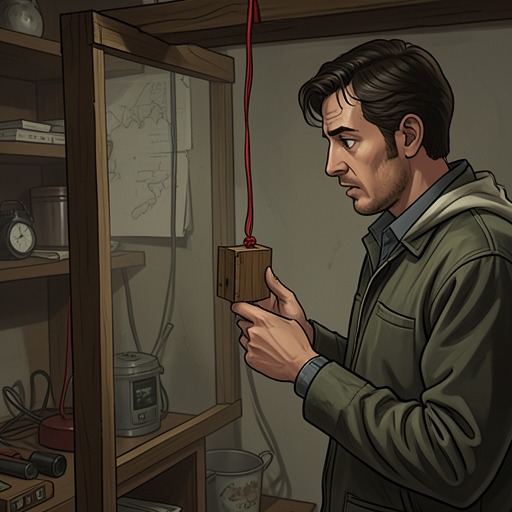
After Brian Kagwa’s birth, Apollo opens the Improbabilia box because he feels ready to add to the time capsule. He removes a children’s book to read to his son and places Emma’s string inside. The thread has become bunched and tight; Apollo pulls it straight and finds four or five inches of frayed red fabric. It seems warm to his touch, as if sentimental magic still clings to it. Alongside the book, he places a worn thriller associated with the night Brian was born and a ticket from that evening, intending to tell Brian the stories behind the objects when his son is old enough. The string belongs not only to the beginning of Apollo and Emma’s relationship but also to the family history Apollo hopes to pass on.
Later, as Apollo and William Wheeler travel by sloop toward the East River, William says they could still turn back. Apollo gives no spoken answer. He wears the red string on his middle finger and his wedding ring on the next; he turns the ring twice, removes it, and tosses it into the river. The narration makes the contrast plain: the string is now his only vow. An object once associated with Emma’s wishes has become, for Apollo, a chosen commitment that remains after he relinquishes the conventional sign of marriage. The ritual’s meaning has shifted again, from Emma’s patient hope to Apollo’s private declaration.
Narrative Significance
The thread connects wish-making to events that the novel treats as thresholds without establishing that the string caused them. At Brian’s birth on the stalled A train, Apollo and Emma share the physical effort of bringing their child into the world; later, Apollo remembers the birth as a moment when their family seemed to exist between ordinary reality and eternity. That memory gives the small piece of red fabric a place within a wider pattern of crossing between states, but it does not confirm that Emma’s wishes came true by supernatural means.
The string’s recurrence instead keeps a promise visible after the circumstances that produced it have changed. Emma’s belief begins as a practice learned from a woman she trusts; Apollo’s cut makes it a shared romantic wager; his preservation of the fragment turns it into a reminder; and its appearance beside his wedding ring makes it a measure of what he is still willing to vow. The thread can be ratty, shortened, and removed from the wrist, yet its significance persists because the characters attach memory and intention to it. The ritual holds open the possibility of magic while grounding its clearest consequences in what Emma and Apollo choose to promise each other.